Knight Cat vs Kitten With a Sword Meme: Which Format Wins
 Knight Cat AI Team
Knight cat vs kitten with a sword meme compared: how the animated knight-cat video and the classic sword-wielding kitten image differ, and when to use each.
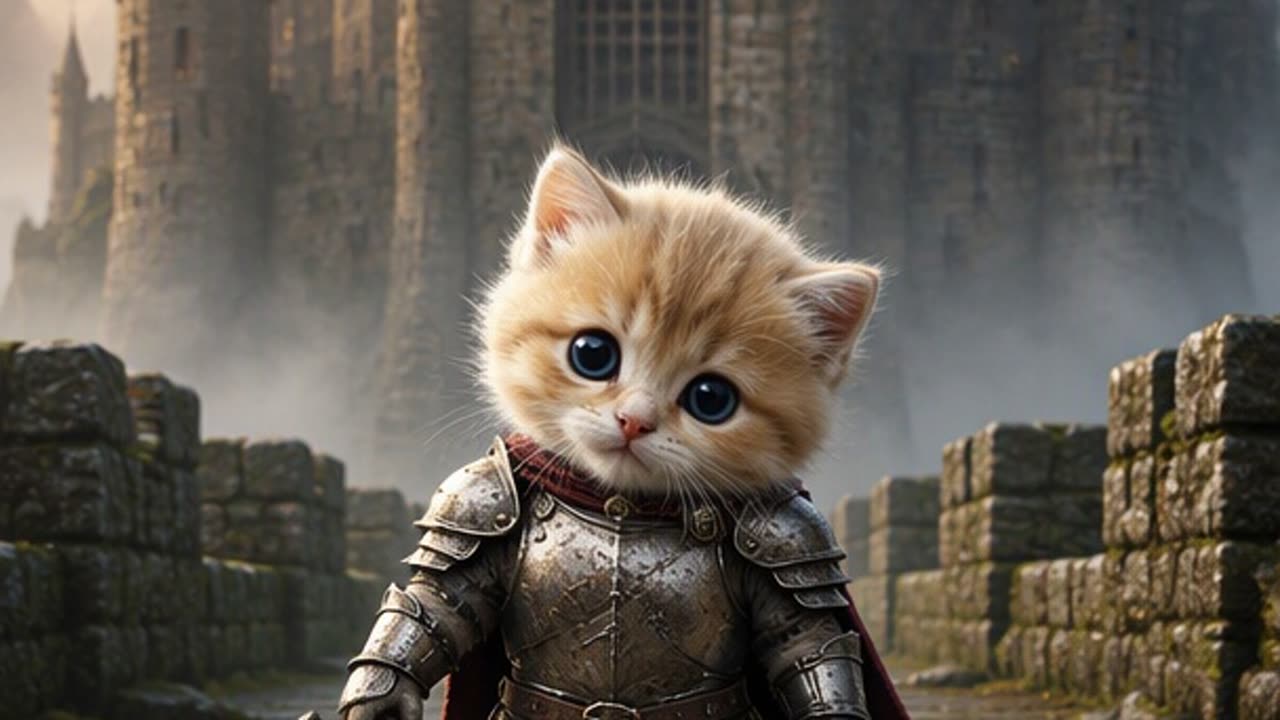
The knight cat versus kitten with a sword meme question is really a question about format, not about subject matter. Both formats put a small domestic animal next to a martial object, but one freezes that contrast into a single still frame while the other animates it as a short clip of your own pet in armour. Choose the animated knight-cat video when you need motion, a specific setting and a recognisable animal, and choose the still sword image when you need a punchline that lands in one glance with no rendering step at all.
What the two formats actually are
The kitten-with-a-sword format is a still image. Someone photographs or edits a cat so that a blade appears in frame, usually held, balanced or resting beside the animal, and the humour comes from the gap between something soft and something dangerous. It is a single frame with a fixed crop, a fixed lighting condition and no time dimension. The caption carries most of the meaning, and the image is infinitely repostable because it never changes.
The knight-cat video format starts from a reference photo of your cat and renders that same animal as a tiny armoured medieval figure. You upload one photo, pick one of four studio presets, and the Seedance 2.0 model produces a vertical 9:16 clip of roughly ten seconds, delivered as an MP4 download. Default delivery is Standard 1080p at 12 seconds for 30 credits, the Standard tier shown on the pricing cards is 720p at 12 seconds for 10 credits, and 480p at 12 seconds costs 5 credits. Renders stay private to your account, there is no watermark, and a failed render is refunded to the source balance.
That difference in production path is what shapes everything below. The still image is a composition problem you solve once. The animated clip is a composition problem plus a motion problem plus an identity problem, and each of those has its own failure modes.
This clip: 30 credits · 6 clips a month for $39.90 (Pro), or 80 a year for $319
The two formats side by side
The fastest way to decide is to read the dimensions where they actually diverge. A table makes the tradeoff visible, because most of the friction people hit is caused by asking one format to do the other format's job.
| Dimension | Kitten with a sword (still) | Knight cat video (animated) | | ------------------ | ----------------------------------------------- | ---------------------------------------------------- | | Motion | None, the frame is frozen | One continuous action across roughly ten seconds | | Wardrobe | Whatever the source photo or edit already shows | Armour generated around your pet by the model | | Identity retention | Depends entirely on the original image | Pinned by the uploaded reference photo | | Reuse | Repost the same file unchanged | Re-render the same photo with a new preset or prompt | | Effort per variant | One image edit or one staged photograph | One upload plus one render pass | | Attention window | A glance, then the caption | Ten seconds of held attention | | Best placement | Static posts, captions, reaction replies | Short-form video feeds and story formats | | Sound | Optional and external | Optional and external, added after the render |
If you only read one row, read the reuse row. A still image is a finished artefact, so variation means starting again from a new image. A rendered clip is a parameter set, so variation means changing one input and running the same pipeline again.
Motion: the dimension the still frame cannot enter
A still image implies motion through pose, blur, wind in fur or a mid-swing blade, but it never delivers motion. The viewer supplies it. That is efficient, and it is also the ceiling of the format, because the joke resolves the instant the eye finishes scanning the frame.
An animated shot resolves over time, which means the action itself becomes the structure of the piece. The mechanism that matters here is one action per shot. A prompt that asks for three separate actions in a ten-second window will smear or silently drop some of them, because the model spreads its attention across competing instructions. One dominant motion, clearly named, survives the render intact. Steps, turns, a single sword lift, or a slow push toward the camera all work. A chase followed by a duel followed by a bow does not.
Camera language is a real parameter in the same way. A locked-off static shot is more stable than a moving one, because the model is not simultaneously solving camera travel and subject motion. When you want the animated format to look deliberate, pair one action with one camera behaviour and stop there.
Wardrobe, props and the armour question
The still format has an honesty advantage. If the blade in the frame is a real object, it is a real object, and the image reads as a photograph of a cat near a sword. Nothing has to be invented, so nothing can be invented badly.
The animated format invents the armour. Your cat's face, markings and ear shape are carried by identity anchoring, which is the mechanism that keeps the animal recognisable while the model replaces its surroundings and outer appearance with plate, cloth and medieval trim. The reference photo pins the parts that matter, and everything else is generated. That is why the armour always reads as generic medieval gear rather than as anything from a specific film, game or franchise. It is a costume constructed by the model, not a reference to an existing work, and the studio does not present it as one.
Because the wardrobe is generated, the prop vocabulary stays broad. A blade, a banner, a lantern, a gate, a milk pail and a storm sky are all prompt-level decisions rather than objects you need to own. The still format requires the object to exist in front of the camera or to be edited in convincingly. The animated format requires only that you describe it.
Identity retention: the real dividing line
This is where the two formats separate most sharply, and it is usually the reason people switch.
With a still image, the cat in the final artefact is the cat in the original photograph. Identity retention is perfect because nothing is regenerated. With an animated clip, retention is a mechanism you can degrade by accident. Identity anchoring holds fur pattern, face shape and markings together as long as the photo gives the model clear evidence to work from.
Break that evidence and the output drifts. The most common failure is the model guessing hidden geometry. If the prompt implies a body pose that the reference photo does not show, such as standing upright on hind legs, the model has to invent the parts it cannot see, and invented parts are where extra limbs appear. A clear reference pose plus a single named action avoids most of this. A full-body, well-lit, unobstructed photo is worth more than a clever prompt.
So the honest framing is that the still format retains identity by construction, and the animated format retains identity by careful input selection. The second is more powerful, because that retained identity can then be moved through settings the original photo never contained.
Reuse, iteration and the cost of a second idea
A still image is a dead end the moment you want a variation. Cropping differently, changing the caption or reposting it does not produce a new idea. Producing a genuinely new idea means a new image, and a new image means new staging, new lighting and new prop work.
The animated format turns variation into a one-line change. The same reference photo can run through Storm-swept moor for weather and atmosphere, Castle gate at dusk for architecture and a sense of threshold, Tiny cat, giant knight for scale contrast between a small figure and a large protector, or Guardian of the milk for a tight prop-led composition. Each of those is a fresh render from the same photo, and each costs a known number of credits before you press generate. At 5 credits for 480p you can test the framing cheaply and only spend 30 credits on the 1080p version once the motion reads correctly.
That iteration loop is the strongest argument for the animated format, and it is also its cost. A still image is finished instantly. A clip is finished after at least one render pass, and often after two or three.
When to use which
Use the still sword format when the joke is the incongruity itself, when you need something that reads in under a second in a comment thread, when you have no usable photo of your own cat, or when you want zero processing time between the idea and the post.
Use the animated knight-cat format when the pet is the point. If the value of the piece comes from the fact that this specific cat, with these markings, is the one wearing the armour, the still format cannot deliver that without heavy editing. Use it also when the setting matters, when you want wardrobe you do not own, when you want the action itself to carry the attention, or when you need a vertical clip sized for a short-form feed rather than a square or landscape image.
A practical sequence that works for most people is to start with the still format as a cheap test of whether the premise is funny at all, then move the same cat into the animated format once the premise proves itself. If you want the wider context first, the knight cat trend overview explains where the format came from as a visual idea, and the knight cat AI video generator page covers the pipeline end to end.
Which format holds up in a feed
Feeds reward two different things. Static surfaces reward instant legibility: the whole image must be understood before the thumb moves, which is exactly what a still sword frame is built for. Video surfaces reward held attention: the clip has to justify its own length, which is what a single well-chosen action does across ten seconds.
That means the animated format usually performs better where autoplay is normal and the still format performs better where captions dominate. It also means the two are not competitors so much as different entries in the same joke. The animated version is the same premise given a timeline.
If you want to see how far the timeline can be stretched across settings before it stops reading, compare the four presets in one sitting using the same photo, and let the cheap 480p tier carry the experiments. More prompt-level detail on action, pose and camera sits in the prompt guide, and the general selection criteria for pet-specific tools are covered in the best AI video generator for pets comparison.
Cost and effort in plain numbers
The still format costs whatever the image cost, which is usually nothing and occasionally a full reshoot. The animated format costs credits, and the pricing is blunt: 480p at 12 seconds is 5 credits, 720p standard is 10 credits, and the 1080p default is 30 credits. Longer clips scale linearly and round up, so a 24-second render is not a discount.
New accounts get 30 credits once through Google sign-in. Email sign-up starts at 0 until the daily check-in is claimed, which grants 10, then 20, then 30, then 10 credits four more times, one per 24 hours. That is enough to test the animated format properly before deciding whether it earns a permanent slot in your posting routine. Current numbers are on the pricing page, and the same studio runs from the home page if you want to try one render before reading anything else.
FAQ
Does the animated format replace the still image format? No. They answer different questions. The still frame answers whether the juxtaposition is funny. The animated clip answers what the cat does inside that juxtaposition, and it needs a usable reference photo to work.
Can I make a knight-cat video without a sword in the prompt? Yes. A blade is one prop among many. Storm-swept moor, Castle gate at dusk and Guardian of the milk all work without a weapon, and the design of each is documented across the preset posts on this blog.
Why did my render produce extra limbs? Almost always because the prompt implied a pose the reference photo did not show. The model invents geometry it has no evidence for. Supply a clear, well-lit, full-body reference and name one action per shot.
Is any of my footage published publicly? No. Renders are private to the account that made them. Nothing is pushed to a public feed, and there is no watermark on the MP4 you download.