What Is the Knight Cat Trend? Armored Pet Video Explained
 Knight Cat AI Team
The knight cat trend explained: why a pet dressed as an armored knight suits short-form feeds, the visual grammar behind it, and how the pet stays recognizable.
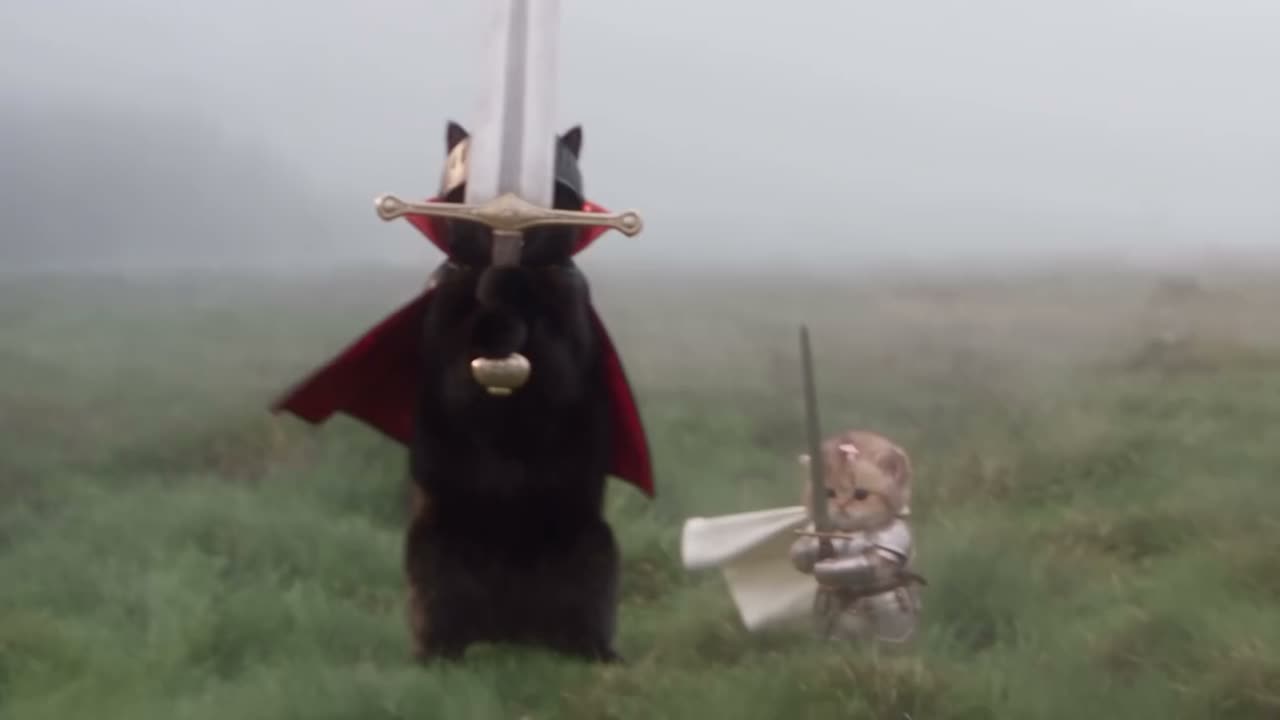
The knight cat trend is the short-form convention of presenting an ordinary household cat as a small armored medieval knight inside a moving vertical clip. The format travels on short-form feeds for three structural reasons: the silhouette reads instantly at thumbnail size, the joke survives muted autoplay because it is carried by costume and scale rather than dialogue, and the pet stays recognizable while its wardrobe and setting change completely.
What the trend actually is
Strip away the aesthetic and the knight cat trend is an output format, not a story. A single photo of a cat is used as a subject reference, a scene description supplies wardrobe, lighting and camera behaviour, and a video model decodes a short sequence in which that same animal appears in plate armour. On this site that model is Seedance 2.0, and the default result is a roughly ten-second vertical 9:16 MP4 that you can download and post wherever you like.
The trend is best understood as a genre with a fixed contract between viewer and creator:
- The subject is a real pet, not an invented character, and it must remain identifiable.
- The costume is medieval and protective, which means metal, leather, banners or torchlight rather than a novelty hat.
- The framing is vertical and the duration is short, so the whole idea lands before a thumb can move.
- There is one dominant action, usually a look, a step or a turn, not a sequence of events.
That contract is why a knight cat clip from one creator feels related to a knight cat clip from another. The presets that ship with the studio encode the same convention: Storm-swept moor, Tiny cat, giant knight, Castle gate at dusk, and Guardian of the milk are four variations on the same grammar.
This clip: 30 credits · 6 clips a month for $39.90 (Pro), or 80 a year for $319
The visual grammar behind the clips
Three choices repeat across almost every clip in the format, and each one does specific work.
Scale contrast. The pet is small and the world around it is large. A cat occupying a modest portion of a tall frame, dwarfed by a gate, a shield or an armoured figure, produces the core tension of the genre. When the animal fills the frame instead, the clip stops reading as a knight cat and starts reading as a pet portrait with a costume.
Warm directional light. Torchlight, low sun and fire glow do two things at once. They justify the medieval setting, and they separate fur from metal, because cool daylight tends to flatten the armour into grey and lose the animal's markings. Warm light from one side also gives the model an obvious source to animate, so flicker on a helmet or a wall reads as motion even when the subject barely moves.
Vertical framing. A 9:16 frame is tall and narrow, which rewards subject height. A standing pet, a raised banner or a tall doorway fills the composition naturally. Horizontal group scenes fight the frame, because everything important ends up compressed into a strip in the middle.
The format compared with other pet video styles
The knight cat clip is not the only way to put a pet on a phone screen. It differs from neighbouring formats in ways that are easy to measure once you name the columns.
| Format | Subject consistency | Motion | Wardrobe | Duration | | ----------------------------------------- | ----------------------------------- | ---------------------------------- | --------------------------- | ----------------------------------- | | Knight cat clip, generated from one photo | High, pinned by the reference photo | One dominant action, model-decoded | Fully replaced by the model | About 10s, 9:16 | | Filmed pet trick | High, the animal is real | Whatever the animal chooses | Only what exists physically | One take, as long as the take lasts | | Photo slideshow with music | High, but frozen | Pan, zoom, cuts | None added | A short carousel or loop | | Generated scene from text only | Lower, no reference to anchor | One dominant action | Fully generated | About 10s, 9:16 | | Costumed photo shoot | High, the animal is real | Static or near-static | Physical, purchased costume | Single frames |
The pattern is straightforward. Filmed clips win on authenticity and lose on wardrobe, because you cannot buy plate armour for a cat at reasonable cost or get the animal to wear it. Slideshows win on effort and lose on motion. Text-only generation wins on scene freedom and loses subject consistency, because nothing pins the fur pattern. A knight cat clip trades some realism for complete control of costume, setting and camera while keeping the pet identifiable, and that trade is the entire point of the format.
Why the vertical frame carries it
Short-form feeds are watched on a phone held at arm's length, frequently with sound off and one thumb hovering. That environment imposes requirements that the knight cat format happens to satisfy.
The first frame has to communicate the idea before anything moves, so a clip opens on the pet already in armour rather than on a build-up. The important information sits in the central band of the frame, because edges are covered by interface elements. Contrast does the work that audio would do in a longer video, which is why metal reflections against dark backgrounds are so common. And the action is legible without reading, because a small animal turning its head inside a large helmet is a complete beat on its own.
None of that depends on any particular clip performing well. It is simply what the frame and the feed reward, and the format was built around those constraints.
How the same animal stays recognizable
This is the mechanism that separates a knight cat clip from a generic fantasy render, and it is worth understanding whether you plan to make one or just want to read the trend accurately.
Identity anchoring. The reference photo pins fur pattern, face shape, eye colour and markings. The model is free to rebuild the surroundings and the clothing, but those identity features are conditioned on your image, so the animal that appears in the armour is recognisably the animal in the photo. This is why a tabby keeps its tabby stripes under a breastplate while the castle behind it is invented from scratch.
One action per shot. A clip that asks for three separate actions in ten seconds will smear or drop some of them, because the model has to compress a lot of change into a small number of frames. A single dominant motion, such as a slow head turn or one deliberate step, stays clean.
Pose honesty. Extra limbs usually appear when the requested pose is one the reference photo does not show. If you ask for a cat rearing on hind legs and your photo shows a cat sitting, the model guesses the hidden geometry and can guess wrong. A reference photo whose pose already resembles the target pose avoids most of that class of error.
Camera discipline. Camera language is a real parameter, not decoration. A locked-off shot with ambient motion is more stable than a fast dolly or a whip pan, because the model has fewer moving parts to keep coherent. When a clip looks warped, the camera instruction is often the cause rather than the subject.
If you want to see how those four rules are applied in practice, the walkthrough in how to make a knight cat AI video builds a clip from a single photo step by step.
What the trend is not
Several assumptions travel with the format and most of them are wrong.
It is not affiliated with any film, game, franchise or real medieval source. The armour is generic plate and the setting is generic castle, and no clip in the format is official material for anything.
It is not a public feed. Renders on this site are private to the account that created them, and nothing is published anywhere by default. There is no watermark on any render, so if you do post a clip, the file is clean.
It is not a filter applied to your existing footage. The video is generated, which means the frames do not exist until the model produces them. Your photo supplies identity, not pixels.
It is not the same thing as the kitten-with-a-sword meme. That format is a caption-led joke built on a single still image, and the humour comes from the mismatch between a harmless animal and a weapon. The knight cat clip is a moving scene with costume, light and camera direction, and the humour or appeal comes from scale and production value rather than the caption. The comparison of the two traditions is worth reading if you want the lineage rather than the spec.
Reading a clip critically
Once you know the grammar, you can spot a generated knight cat clip and judge its quality in a few seconds.
| Check | What good looks like | What failure looks like | | --------------- | ------------------------------------------ | ----------------------------------------------- | | Paws and limbs | Four legs, correct count, plausible joints | Extra limb, fused paw, limb that vanishes | | Identity | Fur pattern matches the reference animal | Pattern drifts between frames or loses markings | | Light direction | One consistent source, stable shadows | Shadow flips direction mid-clip | | Camera | Locked or smoothly travelling | Warping edges, rubbery background |
Those checks also tell you what to change if you are producing rather than watching. Limb errors point at pose honesty, pattern drift points at a weak reference photo, and shadow flips usually point at an over-ambitious camera instruction.
Making one in the format
The workflow is short enough to describe in five steps.
- Choose a reference photo where the cat is lit clearly, faces the camera, and is not cropped at the legs.
- Open the generator and upload that single photo.
- Pick a preset. Castle gate at dusk and Guardian of the milk are the most forgiving because they imply small ambient motion rather than a full-body action.
- Generate at 480p first if you are testing a prompt, since a 480p pass costs 5 credits and lets you check pose and identity before committing.
- Download the MP4 and, if you plan to post it, follow the practical notes in the TikTok guide on captions and cropping.
Pricing is per render and published openly: Standard · 720p · 12s costs 10 credits, and Standard · 1080p · 12s costs 30 credits. Failed renders are refunded to the balance they came from, so an attempt that comes back smeared does not cost you a real try.
FAQ
Is the knight cat trend the same as the kitten with a sword meme? No. The meme is a caption-led still image. The trend is a generated moving clip with a fixed visual grammar, and it is defined by the clip rather than by a joke caption.
Do I need video editing skills to take part? No. You upload one photo and pick a preset. The model handles wardrobe, setting, lighting and camera, so the useful skills are choosing a clear reference photo and describing one action.
Why does the same cat look like the same cat under armour? Because the reference photo conditions the generation on fur pattern, face shape and markings. The wardrobe and background are regenerated, but the identity features are anchored to your image.
Can I post a clip anywhere I want? Renders are private to your account by default and carry no watermark, so the file you download is yours to use. Nothing is published to a public feed on your behalf.
What is the most common cause of a bad render? A prompt that asks for several actions at once, or a pose the reference photo does not show. Both force the model to invent geometry, which is where extra limbs and smearing come from.
If you want the wider context of the format before you generate anything, the blog index and the product overview both start from the same definition: a short vertical clip in which a real pet is cast as a small armored knight while staying recognizable.